Introduction
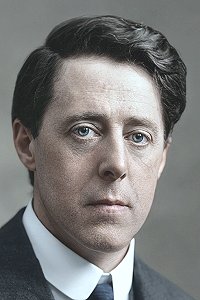
Born: August 10, 1869, Lancaster, Lancashire, England.
Died: March 10, 1943, Reading, Berkshire, England.
Buried: St. Mary the Virgin churchyard, Aldworth, Berkshire, England.
Born: August 10, 1869, Lancaster, Lancashire, England.
Died: March 10, 1943, Reading, Berkshire, England.
Buried: St. Mary the Virgin churchyard, Aldworth, Berkshire, England.
Laurence was the son of Frederick Binyon, vicar of Burton in Lonsdale, Yorkshire, and Mary Dockray, and husband of historian Cicely Margaret Powell (married 1904). Both his parents were of Quaker ancestry.
He was educated at St. Paul’s School in London, and Trinity College, Oxford, where he won the Newdigate Prize in 1891 for his poem Persephone. He also took a first in classical moderations in 1890, and a second in literae humaniores in 1892.
After graduation, he went to work for the British Museum, where he eventually became head of the Department of Oriental Prints and Drawings.
In World War I, he volunteered as a hospital orderly in France, and afterwards worked in England, helping take care of the wounded from the Battle of Verdun.
After retiring from the British Museum in 1933, he joined Harvard University, Cambridge, Massachusetts, as Norton Professor of Poetry.
In 1940, he went to Athens University as Byron Professor of English Literature. However, his stay there was short lived: he left just before the German invasion of Greece in 1941.
Binyon’s most famous work is probably his poem For the Fallen, written in honor of British Expeditionary Force casualties in the World War I Battle of Mons. It was published in the London Times in September 1914, and later set to music in Edward Elgar’s The Spirit of England (London: Novello, 1916).
Binyon’s other works include:
With proud thanksgiving, a mother for her children,
England mourns for her dead across the sea.
Flesh of her flesh they were, spirit of her spirit,
Fallen in the cause of the free.
Solemn the drums thrill; Death august and royal
Sings sorrow up into immortal spheres.
There is music in the midst of desolation
And a glory that shines upon our tears.
They went with songs to the battle, they were young,
Straight of limb, true of eye, steady and aglow.
They were staunch to the end against odds uncounted:
They fell with their faces to the foe.
They shall grow not old, as we that are left grow old:
Age shall not weary them, nor the years condemn.
At the going down of the sun and in the morning
We will remember them.
They mingle not with their laughing comrades again;
They sit no more at familiar tables of home;
They have no lot in our labour of the day-time;
They sleep beyond England’s foam.
But where our desires are and our hopes profound,
Felt as a well-spring that is hidden from sight,
To the innermost heart of their own land they are known
As the stars are known to the night.
As the stars that shall be bright when we are dust,
Moving in marches upon the heavenly plain;
As the stars that are starry in the time of our darkness,
To the end, to the end, they remain.
Laurence Binyon
London Times, September 21, 1914